
WELCOME TO SENTINEL PLUS

This medical education website has been funded by AstraZeneca and co-developed with Hull University Teaching Hospitals NHS Trust. This website is intended for UK healthcare professionals only.

I AM NOT A HEALTHCARE PROFESSIONAL

THIS NON-PROMOTIONAL WEBSITE IS INTENDED FOR UK HEALTHCARE PROFESSIONALS ONLY

Logo
☰
  • HOME
  • WHY SENTINEL MATTERS
    • › THE SENTINEL PLUS STORY
    • › PUBLICATIONS AND POSTERS
  • SENTINEL PLUS TOOLKIT
    • ›HEALTHCARE PROFESSIONAL EDUCATION
    • ›GOLD STANDARD PRESCRIBING PRACTICES
    • ›TARGETED ASTHMA REVIEWS
    • ›PATIENT SUPPORT AND EDUCATION
    • ›REAL TIME DATA MONITORING
  • SENTINEL TEAM
  • CONTACT
  1. WHY SENTINEL PLUS?
  2. SENTINEL PLUS IN PRACTICE

Why SENTINEL Plus?

There is a significant burden of asthma in the UK 1. Currently, around 5.4 million people in the UK are treated for asthma2, yet outcomes remain poor. There were approximately 39,000 emergency admissions for adult asthma attacks in 2024/253 and the rates of hospital admission and mortality in the UK are amongst the worst in Europe.4,5


WHY IT MATTERS FOR PATIENTS

The BTS/NICE/SIGN 2024 asthma guideline places inhaled corticosteroids as the cornerstone of an anti-inflammatory based management approach, advising that no asthma patient should be on short-acting beta 2 agonist (SABA) monotherapy and that all new eligible and uncontrolled asthma patients are started on anti-inflammatory reliever based regimes, such as AIR or MART.7

However, SABAs, which have no inherent anti-inflammatory pharmacological properties8, are the most widely prescribed inhaler treatment in the UK.9 This over-use of SABA inhalers is putting patients at increased risk of severe exacerbations and premature death.10,11

description

WHY IT MATTERS FOR THE ENVIRONMENT

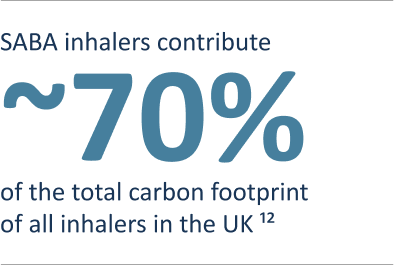
Beyond patient outcomes, SABA inhalers (all devices) have a significant impact on the environment, contributing to ~70% of the total carbon footprint of all inhalers in the UK11. Poorly controlled asthma has also been found to generate 3.1-fold higher overall and 8.1-fold higher excess per capita carbon footprint than well controlled asthma.12

Through identifying and addressing and supporting implementation of guideline recommended care, SENTINEL Plus can improve both clinical and environmental asthma outcomes, aligning with NHS priorities.


SENTINEL
PLUS IN
PRACTICE

These projects were Joint workings between the NHS and AstraZeneca

ANTRIM AND BALLYMENA GP FEDERATION

Joanne Caldwell, Lead General Practice Pharmacist, talks about the experience of implementing SENTINEL Plus within Antrim and Ballymena GP Federation.

DOWNLOAD THE POSTER

ARMAGH/DUNGANNON FEDERATION

This poster, presented at the Winter British Thoracic Society meeting 2025, describes the implementation of SENTINEL Plus in Armagh/Dungannon Federation in 2023. This came after the respiratory index data from Asthma and Lung UK ranked Armagh Banbridge Craigavon council area as 208 of 217 in terms of highest respiratory rate of deaths and emergency admissions - placing it among the worst-performing areas for respiratory health outcomes.

DOWNLOAD THE POSTER

Lancashire and South Cumbria Integrated Care Board

This poster, presented at the Primary Care Respiratory Society and British Thoracic Society 2025 Winter meetings, outlines the results of SENTINEL Plus implementation in Lancashire and South Cumbria Integrated Care Board (ICB). The ICB utilised the SENTINEL approach across 20 practices – covering 14,590 registered asthma patients - between October 2023 to September 2024.

DOWNLOAD THE POSTER

description

Every 10 seconds someone has a potentially life threathening asthma attack in the UK.1

description

2/3 asthma deaths (130/195*) could have been prevented, and the National review of Asthma Deaths identified that overuse of SABA and underuse of inhaled corticosteroids as a key risk factor.5

description

Patients prescribed 3 or more SABA inhalers per year are at an increased risk of severe exacerbation, emergency department attendance, and premature death.1,10,11

description

~3x SABA related GHG emissions observed in the UK than in other large European countries.12

References

  1. Bloom, C.I., et al. (2020) ‘Asthma-related health outcome s associated with short-acting β2-agonist inhaler use: an observational UK study as part of the SABINA global program’, Advances in Therapy, 37(10), pp. 4190–4208. Available at: https://doi.org/10.1007/s12325-020-01444-5 (Accessed: 7 May 2026). 
  2. National Institute for Health and Care Excellence (NICE). Asthma: How common is it? Available from https://cks.nice.org.uk/topics/asthma/background-information/prevalence/ Accessed: May 2025
  3.  Department of Health and Social Care. Public health profiles – asthma. https://fingertips.phe.org.uk/respiratory-disease#page/4/gid/8000003/pat/159/par/K02000001/ati/15/are/E92000001/iid/93573/age/298/sex/4/cat/-1/ctp/-1/yrr/1/cid/4/tbm/1/page-options/tre-do-0 
  4. The Pharmaceutical Journal. Asthma-related death rate in UK among highest in Europe, charity analysis finds. Available at: https://pharmaceutical-journal.com/article/news/asthma-related-death-rate-in-uk-among-highest-in-europe-charity-analysis-finds 
  5. Royal College of Physicians (2014) Why asthma still kills: the National Review of Asthma Deaths (NRAD) Confidential Enquiry report. London: Royal College of Physicians. Available at: https://www.rcp.ac.uk/media/i2jjkbmc/why-asthma-still-kills-full-report.pdf [Accessed May 2026] 
  6. Asthma + Lung UK. (2024) Ten years gone: Asthma care in the UK since the National Review of Asthma Deaths (NRAD). 
  7. National Institute for Health and Care Excellence (2024) Asthma: diagnosis, monitoring and chronic asthma management (NG245). Available at: https://www.nice.org.uk/guidance/ng245 (Accessed: May 2026) 
  8. Kaplan, A et al. J Clin Med 2020; 9(4): 921 
  9. Wilkinson A. et al. Thorax 2021;76:A19. 
  10. Schatz M, et al. J Allergy Clin Immunol. 2006;117:995-1000 
  11. Nwaru Bl et al. Eur Resp J. 2020 55: 1901872; doi: 10.1183/13993003.01872-2019 
  12. Wilkinson, AJK et al. BTS Oral Abstract No: S26. Available from http://dx.doi.org/10.1136/thorax-2020-BTSabstracts.32

GB-76227 | May 2026

SENTINEL Plus is developed with the aim of improving outcomes for asthma patients through identifying and addressing short-acting beta 2 agonist (SABA) over-reliance

SITE PAGES

  • Home
  • Why SENTINEL matters
  • SENTINEL Plus Toolkit
  • SENTINEL Team
  • Contact

LEGAL

  • Terms of use
  • Privacy Policy
  • Cookie Policy

GB-76210 | May 2026

2026 SENTINEL Plus

SENTINEL Plus is a quality improvement framework, providing educational resources. This non-promotional website is funded by AstraZeneca and co-developed with Hull York Medical School and Hull University Teaching Hospitals NHS Trust. Intended for UK Healthcare Professionals Only.